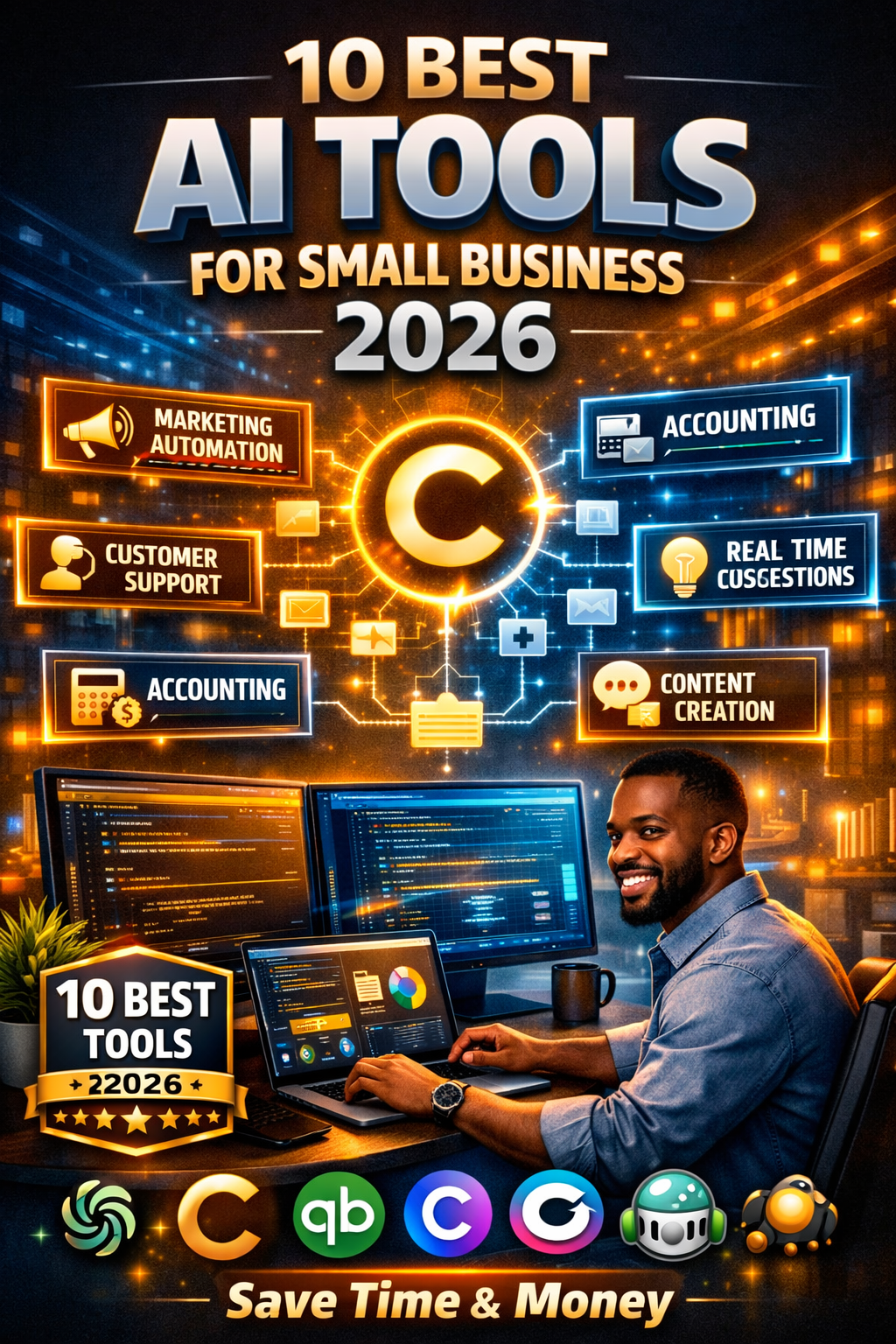

Running a small business in 2026 means competing with larger companies that have bigger teams, bigger budgets, and more resources. The good news is that artificial intelligence has leveled the playing field. Today, small business owners and solopreneurs have access to AI tools that can automate marketing, handle customer service, generate content, manage finances, and streamline operations at a fraction of the cost of hiring additional staff.
In this guide, we break down the best AI tools for small businesses in 2026, covering what each tool does, who it is best for, and how much it costs. Whether you are a freelancer, a retail shop owner, a service provider, or an e-commerce entrepreneur, there is an AI tool on this list that will save you time and money.
What to Look for in an AI Tool for Small Business
Before diving into specific tools, it is worth understanding what separates a genuinely useful AI tool from one that looks impressive in a demo but delivers little practical value. The best AI tools for small businesses share four key characteristics. First, they solve a specific, recurring problem that costs you time or money. Second, they are easy to use without requiring technical expertise. Third, they integrate with the software you already use. Fourth, they offer a clear return on investment, meaning the time or money they save exceeds what you pay for them.
With those criteria in mind, here are the top AI tools for small businesses in 2026, organized by business function.
Best AI Tools for Content Creation
1. Claude AI — Best for Long-Form Content and Business Writing
Claude AI, developed by Anthropic, is one of the most capable AI writing assistants available in 2026. It excels at producing long-form content such as blog posts, whitepapers, case studies, and email sequences that read naturally and accurately. Claude is particularly valuable for small businesses that rely on content marketing to attract customers, because it can research a topic, generate a structured outline, and write a complete draft in a fraction of the time it would take a human writer.
Claude is also exceptional at business writing tasks such as drafting proposals, writing job descriptions, creating onboarding documents, and producing professional email templates. For small business owners who wear many hats, Claude functions as an on-demand writing assistant available at any hour. Pricing starts at free with limited usage, with paid plans beginning around twenty dollars per month for professional-level access.
2. Jasper — Best for Marketing Copy and Ad Creative
Jasper is an AI writing platform specifically designed for marketing teams and small businesses that need high-converting copy at scale. It excels at creating product descriptions, Google Ads copy, Facebook ad creative, landing page text, and social media posts. Jasper includes templates for dozens of marketing use cases, making it easy to produce consistent on-brand content without starting from a blank page. For small businesses running paid advertising campaigns, Jasper can significantly reduce the time spent on copywriting while improving ad performance through AI-optimized messaging.
Best AI Tools for Customer Service
3. Tidio — Best AI Chatbot for Small Business Websites
Tidio is an AI-powered customer service platform that combines live chat, chatbots, and automation in one tool. For small businesses that cannot staff a full-time support team, Tidio’s AI chatbot handles common customer inquiries automatically, including questions about pricing, availability, shipping, and returns. The AI learns from your website content and past conversations, becoming more accurate over time. Tidio integrates with Shopify, WordPress, WooCommerce, and most major e-commerce platforms. Free plans are available for small websites, with paid plans starting around twenty-nine dollars per month for businesses with higher chat volumes.
4. Intercom — Best for Growing Businesses Scaling Support
Intercom is a more comprehensive customer communication platform that uses AI to route, prioritize, and respond to customer inquiries across multiple channels including email, chat, and social media. Its AI features include automated responses to common questions, intelligent ticket routing, and customer sentiment analysis. Intercom is best suited for small businesses that are growing rapidly and need to scale customer support without proportionally growing their support team. It is more expensive than basic chatbot tools, but the ROI for businesses with high customer inquiry volumes is significant.
Best AI Tools for Marketing and Social Media
5. Buffer with AI Assistant — Best for Social Media Management
Buffer is a well-established social media scheduling platform that has integrated AI capabilities to help small businesses create and schedule content more efficiently. Buffer’s AI assistant can generate post ideas, write captions based on your brand voice, suggest optimal posting times based on your audience engagement data, and repurpose existing content for different platforms. For small business owners who need to maintain a consistent social media presence without spending hours each week creating content, Buffer with its AI features is one of the most cost-effective solutions available. Plans start at free for basic scheduling with paid plans beginning at eighteen dollars per month.
6. Canva Magic Studio — Best for Visual Content Creation
Canva’s Magic Studio brings AI-powered design to small businesses that do not have a graphic designer on staff. With Magic Studio, you can generate images from text descriptions, remove backgrounds automatically, resize designs for different platforms with one click, and create brand-consistent visual content at scale. The AI design assistant can take a basic brief and produce social media graphics, presentation slides, flyers, and marketing materials that look professionally designed. Canva Pro, which includes full Magic Studio access, costs around fifteen dollars per month and represents outstanding value for small businesses with ongoing design needs.
Best AI Tools for Business Operations
7. Zapier with AI Actions — Best for Workflow Automation
Zapier has long been the standard tool for connecting apps and automating workflows without code, and its AI Actions feature has made it even more powerful for small businesses. AI Actions allow you to incorporate Claude, ChatGPT, and other AI models directly into your automated workflows. For example, you can build a Zap that automatically receives a new customer inquiry from your contact form, sends it to Claude for analysis and drafting, and emails the completed response draft to your team for review. These multi-step AI-powered workflows save small businesses dozens of hours per month on repetitive communication and data tasks. Pricing starts at approximately twenty-five dollars per month for small business plans.
8. Notion AI — Best for Team Knowledge Management
Notion AI transforms Notion, already a popular workspace tool for small teams, into an intelligent knowledge management system. Notion AI can summarize long documents, extract action items from meeting notes, generate first drafts of procedures and policies, answer questions based on your existing documentation, and translate content into multiple languages. For small businesses building internal knowledge bases, standard operating procedures, or client documentation, Notion AI dramatically reduces the time spent writing and organizing information. Notion AI is available as an add-on to any Notion plan for around ten dollars per user per month.
9. QuickBooks with AI Insights — Best for Financial Management
QuickBooks has integrated AI-powered financial insights that help small business owners understand their cash flow, identify unusual expenses, forecast revenue, and prepare for tax season more efficiently. The AI analyzes your transaction data and surfaces actionable recommendations such as which expenses to review, when cash flow may become tight, and how your business compares to industry benchmarks. For small business owners who are not financial experts, having an AI that can interpret financial data and explain it in plain language is genuinely valuable. QuickBooks plans for small businesses start at around thirty dollars per month.
Best AI Tools for Sales and Lead Generation
10. HubSpot with AI Features — Best Free CRM with AI
HubSpot’s free CRM now includes a range of AI features that are particularly valuable for small businesses building a sales process. AI tools in HubSpot include email writing assistance, call transcription and analysis, lead scoring based on behavior patterns, and automated follow-up sequences. The AI can also analyze your sales pipeline and identify deals that are at risk of being lost, allowing you to intervene before opportunities slip away. HubSpot’s free tier is remarkably capable for small businesses, with paid plans offering more advanced AI features starting at around fifty dollars per month.
How to Choose the Right AI Tools for Your Small Business
With so many AI tools available, the temptation is to adopt as many as possible. This approach typically leads to tool overload, fragmented workflows, and wasted subscription fees. A better strategy is to identify your two or three biggest time drains in your business and find AI tools specifically designed to address those areas.
Start by tracking where you spend the most time each week. For many small business owners, the biggest time drains are content creation, customer communication, and administrative tasks. Choose one AI tool for each category, use it consistently for thirty days, and measure the time saved before adding more tools to your stack.
Also consider the total cost of ownership. Many AI tools offer free trials but charge significant monthly fees for the features that are actually useful. Calculate whether the time you save is worth the subscription cost. As a general rule, if an AI tool saves you more than two hours per week on tasks that would otherwise require your time or a paid contractor, the economics are likely in your favor.
The Bottom Line on AI Tools for Small Business in 2026
Artificial intelligence is no longer a luxury reserved for large enterprises. In 2026, small business owners who leverage AI tools effectively can compete with much larger competitors on content quality, customer service speed, marketing sophistication, and operational efficiency. The tools listed in this guide cover the full spectrum of small business needs, from writing and design to customer service, sales, and financial management.
The most important thing is to start. Pick one tool from this list that addresses your biggest current challenge, commit to learning it properly, and measure the results. Once you experience the time savings and quality improvements that AI can deliver, expanding your AI toolkit becomes a straightforward business decision. The businesses that build strong AI capabilities today will have a significant head start as these tools continue to improve over the coming years.
⭐ Editor’s Pick
Jasper AI — Best AI Writing Assistant for Businesses
Generate blog posts, emails, social media content, and ads in seconds. Used by 100,000+ businesses worldwide.