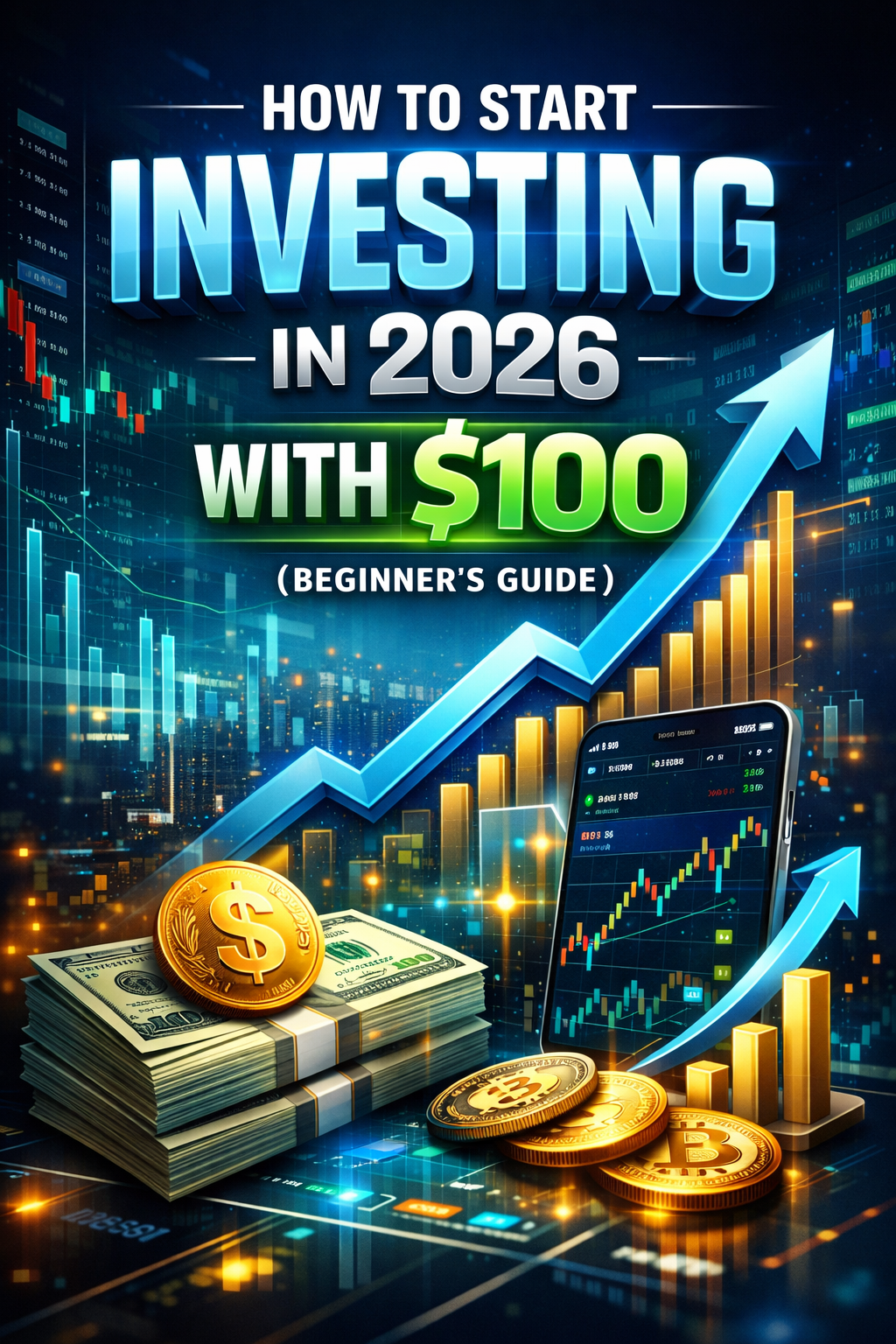

How to Start Investing in 2026: Complete Beginner’s Guide
Disclaimer: This article is for educational purposes only and does not constitute financial advice. All investing involves risk, including possible loss of principal. Past performance does not guarantee future results. Consult a qualified financial advisor before making investment decisions.
The single most common financial regret among Americans over 40 is not starting to invest earlier. Not investing in the wrong thing. Not losing money. Simply not starting.
⭐ Editor’s Pick
Betterment — Best Robo-Advisor for Beginners
Automated investing, tax-loss harvesting, no minimum balance.
The math is unforgiving: $5,000 invested at age 25 grows to approximately $74,000 by age 65 at a 7% average annual return. The same $5,000 invested at age 35 grows to only $38,000. The 10-year delay costs $36,000 — without ever putting in another dollar.
In 2026, there has never been a better time for beginners to start investing. Zero-commission brokers, fractional shares, and low-cost index funds have removed every barrier that once made investing feel inaccessible. This guide walks you through every step.
Step 1: Build Your Financial Foundation First
Before you invest a single dollar in the stock market, make sure your financial house is in order. Investing with a shaky foundation is like building on sand.
Emergency Fund — Non-Negotiable
Keep 3–6 months of living expenses in a high-yield savings account (4.25%–4.65% APY in 2026 — see our guide to the best HYSAs). This is your buffer so a car repair or medical bill never forces you to sell investments at a bad time.
High-Interest Debt — Pay This Off First
Any debt above 7–8% interest rate should be paid off before you invest. Credit card debt at 20–25% APR is a guaranteed -20% return on your money. The stock market’s average annual return is about 7–10%. The math is simple: eliminate high-cost debt first.
Budget Surplus — Know Your Investing Number
Calculate how much you can invest each month without impacting your essential expenses. Even $50/month invested consistently beats $500 invested once and then forgotten.
Step 2: Choose Your Investment Account
Where you invest matters almost as much as what you invest in — because taxes can dramatically affect your long-term returns.
401(k) or 403(b) — Start Here If Your Employer Matches
If your employer offers a 401(k) match, contribute at least enough to get the full match before doing anything else. A 100% match is a guaranteed 100% instant return — nothing in the market comes close.
- 2026 contribution limit: $23,500 (under 50), $31,000 (50+)
- Traditional 401(k): Contributions are pre-tax; you pay tax on withdrawal in retirement
- Roth 401(k): Contributions are after-tax; withdrawals in retirement are tax-free
Roth IRA — Best Account for Most Beginners
If your employer doesn’t offer a match, or you want additional tax-advantaged savings, the Roth IRA is the best starting point for most beginners.
- 2026 contribution limit: $7,000 ($8,000 if 50+)
- Contributions are after-tax — growth and withdrawals in retirement are completely tax-free
- Income limit to contribute: $161,000 (single) / $240,000 (married filing jointly)
- Available at Fidelity, Vanguard, Charles Schwab, and most major brokers for free
Traditional Brokerage Account — No Limits, No Restrictions
Once you’ve maxed out tax-advantaged accounts, a regular taxable brokerage account offers unlimited contributions with no restrictions on withdrawals. You’ll pay capital gains tax on profits, but the flexibility is unmatched.
Step 3: Understand Your Investment Options
You don’t need to understand every financial instrument ever invented. You need to understand three things well.
Index Funds — The Beginner’s Best Friend
An index fund is a basket of stocks that tracks a market index (like the S&P 500). When you buy an S&P 500 index fund, you own a small piece of 500 of America’s largest companies in one purchase.
- Why they work: Over any 20-year period in history, the S&P 500 has been positive. The long-term average return is approximately 10% annually before inflation (7% after).
- Low cost: The best index funds charge expense ratios of 0.03%–0.05% per year. That’s $3–$5 per $10,000 invested annually.
- Examples: Fidelity ZERO Total Market Index (FZROX, 0% expense ratio), Vanguard S&P 500 ETF (VOO, 0.03%), Schwab Total Stock Market Index (SWTSX, 0.03%)
ETFs (Exchange-Traded Funds) — Index Funds You Can Trade Like Stocks
ETFs work like index funds but trade on stock exchanges throughout the day. For practical purposes, a beginner can treat index fund ETFs and traditional index funds identically. The key advantage of ETFs: they can be bought as fractional shares for as little as $1.
Individual Stocks — For Later
Individual stocks carry significantly more risk than index funds (a single company can go bankrupt; the S&P 500 cannot). As a beginner, limit individual stocks to a maximum of 5–10% of your portfolio. Build your foundation with index funds first.
Bonds — For Stability
Bonds are loans you make to governments or corporations in exchange for regular interest payments. They’re less volatile than stocks but offer lower long-term returns. A common rule: hold a percentage of bonds equal to your age. At 30, hold 30% bonds. Most investment professionals consider this too conservative in 2026’s low-rate environment — many recommend 10–20% bonds for investors under 50.
Step 4: Build Your First Portfolio
For most beginners, the simplest and most effective portfolio is a two-fund or three-fund portfolio.
The One-Fund Portfolio (Simplest)
Buy a single Target-Date Fund set for your estimated retirement year (e.g., Vanguard Target Retirement 2055 if you plan to retire around 2055). The fund automatically holds a mix of stocks and bonds and adjusts the allocation to become more conservative as you approach retirement. This is the “set it and forget it” option. Expense ratio: typically 0.12%–0.15%.
The Three-Fund Portfolio (Most Recommended)
This is the classic approach recommended by Bogleheads and most fee-only financial advisors:
- US Total Stock Market Index Fund (e.g., FSKAX, VTI, SWTSX) — ~60% of portfolio
- International Stock Market Index Fund (e.g., FZILX, VXUS, SWISX) — ~20% of portfolio
- US Bond Market Index Fund (e.g., FXNAX, BND, SWAGX) — ~20% of portfolio
This three-fund portfolio gives you exposure to thousands of companies globally while keeping costs near zero. Adjust the stock/bond ratio based on your risk tolerance and time horizon.
Step 5: Automate and Stay Consistent
The biggest threat to investment returns is not market crashes — it’s investor behavior. Panic-selling during downturns and chasing hot investments are the two most common ways beginners destroy their returns.
Dollar-Cost Averaging — The Strategy That Removes Emotion
Invest a fixed amount on a fixed schedule regardless of what the market is doing. If you invest $200 every month, you automatically buy more shares when prices are low and fewer when prices are high. Over time, this averages out your cost basis and removes the impossible task of “timing the market.”
Set Up Automatic Investments
Every major broker (Fidelity, Vanguard, Schwab, Robinhood) allows you to set up automatic recurring investments. Set it once and the money moves automatically on your chosen schedule. This is the single most effective thing you can do to stay consistent.
Stay the Course During Market Downturns
The market will drop 20%, 30%, even 50% at some point during your investing life. Every single major market crash in history has been followed by a full recovery and new all-time highs. The investors who lost money were those who sold during the crash. The investors who gained were those who kept buying (or at minimum, didn’t sell).
Common Beginner Mistakes to Avoid
- Waiting for the “right time” to invest: Time in the market always beats timing the market. Every year you wait costs you compounding. Start now.
- Checking your portfolio daily: Short-term volatility is noise. Looking at your portfolio every day causes anxiety and impulsive decisions. Check quarterly at most.
- Paying too much in fees: A 1% management fee sounds small. Over 30 years, it costs you 25% of your final balance. Use low-cost index funds (expense ratios under 0.10%).
- Chasing last year’s best performers: Last year’s top-performing fund almost always underperforms in the following year. Past returns do not predict future results.
- Putting all money in one stock: Diversification is the only free lunch in investing. Index funds give you instant diversification across hundreds or thousands of companies.
- Ignoring tax-advantaged accounts: Investing in a taxable account before maxing your Roth IRA and 401(k) match is leaving free money on the table.
Best Investing Apps for Beginners in 2026
| App | Best For | Minimum | Key Feature |
|---|---|---|---|
| Fidelity | All-around best broker | $0 | ZERO expense ratio funds, best UI |
| Vanguard | Index fund purists | $1 (ETFs) | Inventor of index funds, non-profit structure |
| Charles Schwab | Full-service investing | $0 | Fractional shares, excellent research tools |
| Robinhood | Simplest mobile experience | $1 | Clean UI, crypto available, easy onboarding |
| Acorns | Micro-investing beginners | $0 | Round-up investing, automatic portfolio |
Frequently Asked Questions: Investing for Beginners 2026
How much money do I need to start investing?
You can start with $1. Fractional shares at brokerages like Fidelity, Schwab, and Robinhood let you buy a portion of any stock or ETF for as little as $1. The more meaningful question is: what can you commit to investing consistently each month? Even $25/month invested in a broad market index fund creates meaningful wealth over 20–30 years.
Is it safe to invest in stocks?
All investing carries risk — you can lose money. However, investing in a diversified index fund over a long time horizon (10+ years) has historically been reliable. The S&P 500 has never failed to recover from any crash in its 100+ year history. Short-term investing (under 5 years) in stocks is significantly riskier than long-term investing.
What is the difference between a stock and an ETF?
A stock is a share in one company. An ETF (Exchange-Traded Fund) is a collection of many stocks bundled together and traded on an exchange. Buying an S&P 500 ETF like VOO gives you exposure to all 500 companies in the S&P 500 index in one purchase. ETFs provide instant diversification that would be impossible to replicate by buying individual stocks.
What is a Roth IRA and why is it recommended for beginners?
A Roth IRA is a retirement account where you contribute after-tax money. Your investments grow tax-free, and when you withdraw in retirement (after age 59½), you pay zero taxes on the gains. For a 25-year-old investing $7,000 in a Roth IRA annually, the tax-free growth over 40 years can easily represent $100,000–$200,000 in saved taxes compared to a taxable account. It’s one of the most powerful tax advantages available to individual investors.
How long should I invest for?
The stock market rewards patience. The longer your time horizon, the more reliable equity investing becomes. Historically, any 20-year period in the S&P 500 has been positive. For money you need within 5 years, use a high-yield savings account or short-term bonds instead of stocks.
Betterment
M1 Finance
Conclusion: The Best Time to Start Investing Was Yesterday. The Second Best Time Is Today.
Every day you wait to start investing is compounding working against you instead of for you. The good news: starting is genuinely simple in 2026.
Here’s your action plan:
- This week: Open a Fidelity or Schwab account (free, takes 10 minutes)
- This week: Set up a Roth IRA if you’re eligible
- This month: Make your first investment in a total market index fund (FZROX, VTI, or SWTSX)
- This month: Set up automatic monthly contributions — even $50
- Going forward: Don’t look at it for 6 months. Then check quarterly. Leave it alone.
You don’t need to understand options, derivatives, sector rotation, or macroeconomics to build wealth. You need to start early, invest consistently, keep costs low, and leave it alone. That’s it. The market will do the rest.
All return figures are historical averages and not guaranteed. This article is for educational purposes only and does not constitute personalized financial advice.